Showing posts with label dogs. Show all posts

Saturday, October 13, 2018

Ninth Annual FMS Scarelicious October Movie Series: #7 The Company of Wolves

Of all the horror movies I watch, monster movies are my favorites.  And of all the monster movies (which to me include zombie flicks), I like werewolf movies the best.  The problem is, for some reason there just aren't that many good werewolf movies.  American Werewolf in London - yes oh yes.  Ginger Snaps - you betcha.  Dog Soldiers - can I get a hell-yes.  But past that, pickings get slim.  (The Underworld series = ugh.)

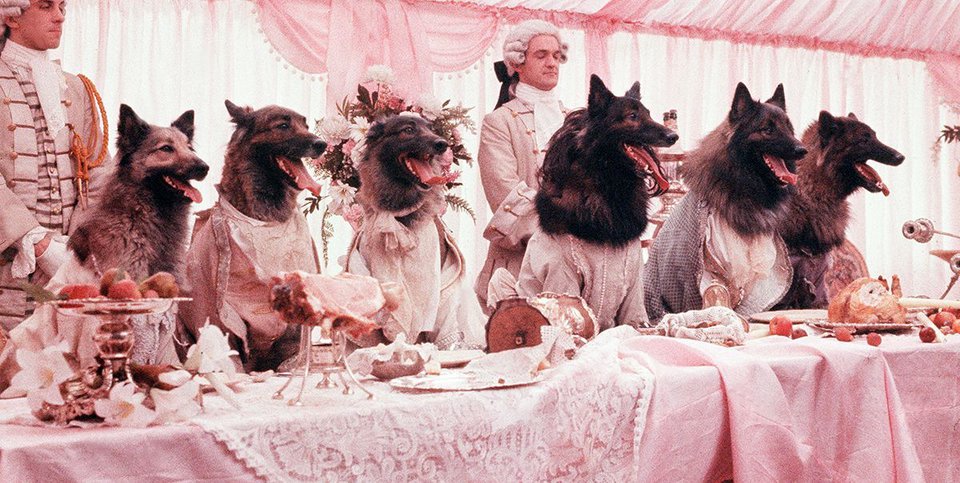
So I've tried to search out some more wolves this year and I found this one:  The Company of Wolves, directed by Neil Jordan (The Crying Game, etc.) with a screenplay credit by Angela Carter, who based it on her short story of the same name from her short story collection, The Bloody Chamber.  It's from 1984 and is more nightmarish fairy tale than out and out horror, although there is one particularly gruesome transformation sequence where the transforming werewolf (Stephen Rea) strips off his human skin before wolfing out.

The outside framework of the movie is set at the country estate of a wealthy family.  The younger daughter is having fever dreams, including one where she and her family are living in Ye Olden Times.  This dream is the main setting of the movie, with characters telling additional stories within the dream.  Werewolves plague Ye Olden Times, werewolves plague the inserted stories - (1) a bridegroom leaves his wife on their wedding night, returning years later and wolfing out when she hasn't waited for him; (2) a boy wolfs out when trying out some snake oil potion; (3) a scorned village witch turns her former lover's wedding party into wolves and makes them howl for her every evening; (4) a wolf girl seeks refuge at a church - and at the end, werewolves break into the younger daughter's waking world, heralding the loss of her innocence.

Some of the images are quite striking, especially the transformed wedding party and the wolves running through the country estate.  The movie itself is a little disjointed - I'm not sure the country estate framework story really worked - but I really enjoyed the fairy tale aspect.

Image result for the company of wolves
Photo: www.aoaff.gr

Tuesday, January 6, 2009

Awwwwwwwwwwwwwwwwwww!!!!

It's not even a full week into January and I've just seen the sweetest, cutest thing I think I'll see all year. If you are not heartwarmed by this, then you are probably a dead person. A mean, cranky, dead person.


Click here to visit the Elephant Sanctuary site.

Thanks to CBS.com and YouTube, and to Mr. Mouse for letting me know about this in the first place.

Friday, May 23, 2008

Harbingers of Spring

I think spring has finally arrived in Maine. You can tell by the advent of blackflies, turnpike traffic, blooming forsythia, the sound of lawnmowers sputtering to life and formerly fuzzy dogs now flaunting their sleek summer-cuts. Case in point:

Becky last night


Becky this afternoon


Tuesday, April 1, 2008

This Rural Life II


The other day I went to feed my dog as I always do, right around 6:00 p.m. (For an animal with a very little brain, Becky has a real knack for knowing when it’s about to turn 6 – either morning or evening, she just knows when it is and turns her crazy on full blast, tap-dancing around the kitchen, making Chewbacca noises … it’s a whole show.) I took the dog dish out to the mudroom where the dog food is kept in a plastic kitchen-size trashcan. I flipped up the lid, picked up the metal measuring cup and scooped up a scoop of dog food. Standard Operating Procedure.

For some reason I glanced at the scoop of food rather than just dumping it into the dog dish. There, curled up on his side, fitting perfectly in the cup and staring right at me with a shiny, unblinking black button of an eye, was a mouse. Not S.O.P.! I gave a little squeak of surprise and dropped the cup back into the barrel, mouse and all. (What a frickin’ girl – jeesh.) After about three seconds I realized I was being a complete twinkie and peeked into the barrel just in time to see that illicit mouse frantically digging his way down into the dog kibble. Gingerly I scooped out Becky’s dinner – she was completely beside herself at this point – and closed the lid, leaving the little critter alone while I considered my next steps.

As I’ve mentioned before, I like mice. I used to have a couple of white ones as pets and I used to have an invisible person-sized one as an imaginary friend when I was a little girl. I could appreciate this little guy’s ingenuity: he was safe (mostly) in a dark and quiet (mostly) place, surrounded by all the food he could ever hope to eat – it was just his bad luck that I scooped when I did.

Problem is, I’m also pragmatic about the little varmints, never shedding tears when the family cats would leave mouse-pieces on the front porch; and I particularly don’t care to have mice scurrying loose around my house, leaving teeny mouse-poops in the cupboards. Plus, who knew what sort of nasty germs he was dragging around with him. I didn’t think Becky would get sick from eating food a mouse had been sleeping and/or pooping in, but I didn’t know for sure.

Here is how you get a pest mouse out of a plastic dog food barrel if you’re not sure he can climb back up the smooth plastic: you drape some clothesline inside the barrel, running it up and over the side with the other end resting on the garage floor. Now, at this point you have a couple of options. You can just leave well enough alone and hope that the little scutter will find his way outside again, a free mouse once more. Or you could place a covered mousetrap baited with extra-crunchy peanut butter nearby, check back the next day and toss the sprung trap in the garbage. I’m not saying which way I went because I don’t want to get the PETA people all up at arms if I picked the first option – which I’m not saying for sure that I did. However, I do have it on good authority that if you have red squirrels, another type of varminty rodent, in your attic, peanut butter gets them in the Havahart trap every time. I'm just sayin'.

Saturday, February 2, 2008

Puppies, the return of Spike and oh, a book

If you're not that interested in either the Giants or the Patriots (or the ads in between the football), Animal Planet offers an excellent alternative to the Superbowl: Puppy Bowl IV. Mr. Mouse and I have watched this for the last couple of years and it is hilarious, heart-warming and oh-so fuzzy. There's a kitten half-time show but my favorite part is the Bowl-Cam. Be sure to check it out.

The season premiere of Torchwood's Season 2 was last Saturday night and it was fantastic to see James Marsters guest-starring as a blast from Captain Jack Harkness's past. Marsters was channeling early Spike for sure, full of swagger, sex appeal, British accentyness and unrepentant evil. And that much ballyhooed kiss between him and John Barrowman? DAMN sexy. Marsters is said to be returning for several more episodes as the season goes on to which I say bravo.

Finally, I guess I should mention the last book I read: Amy and Isabelle by Elizabeth Strout. I'm not giving this one a full review because I didn't really like it. Set in a mill town, the story is about a single mother struggling to raise her 16-year old daughter. The writing was fine if unremarkable; I didn't like any of the characters; and the reveal of the mother's big harrowing secret turned out to be an inconsequential let-down. Anyway, I'm putting it in the "already read" stack and moving onto something else.

Thursday, January 17, 2008

Book review: The Sport of Schutzhund: a Photographic Essay by BJ and Peter Spanos


I have a dog. Her particular skill set includes inhaling her food, sleeping on the couch, sleeping on the bed, sleeping under the bed (in the event of thunderstorms) and begging. The gorgeous dogs portrayed in the coffee table book, The Sport of Schutzhund: A Photographic Essay, are slightly more ambitious than that.

Schutzhund, from the German for “protection dog” is an international competition by which working dogs prove that they are worthy of the group. As herding trials show what border collies can do, Schutzhund trials put German Shepherds (and, to a lesser extent, Doberman Pinschers, Rottweilers, Giant Schnauzers, Belgian Malinois and other large, protective breeds) through their paces. The trials seek out dogs with courage, intelligence and a drive to serve.

There are three parts to a Schutzhund trial: tracking, obedience and protection. Tracking utilizes the dog’s expert nose as a track is laid out with turns over grass, dirt or brush and then “aged” for at least twenty minutes. The dog must – on its own as the handler follows the dog from a specified distance – follow the track and find the target articles that have been hidden along it. Obedience skills include heeling, lying down out of a run, jumping hurdles, scaling walls, retrieving dumbbells and coming when called. The protection test is the most dramatic: the dog must search for and find the hidden target (a person wearing plenty of padding and body armor); hold the target in place by a menacing bark only; and, in various intensities, catching and releasing the target upon command.

The Sport of Schutzhund: A Photographic Essay is a large soft-cover book filled with glossy color photographs, some professionally taken but most, it seems, submitted by Schutzhund enthusiasts who are also amateur photographers. It has some text, enough to explain the sport in broad strokes and to introduce the next group of photographs, which include images of the three trial stages (both training sessions and competition), dogs at play and some wonderful puppy pictures. This is not meant to be a history book or a training manual: the authors are simply hoping to introduce the sport to a broader audience.

A hardcover book would be easier to handle – the large size of the pages makes it a little unwieldy – but since the authors are donating the net proceeds, after expenses, to benefit Schutzhund organizations, I understand the need to keep costs down. The hundreds of photographs are largely wonderful, showing the strength and skill of these animal athletes; the few pictures that are obviously taken by amateurs more than compensate for lack of photographic experience by an abundance of love for their subjects.

Schutzhund trials were introduced to the United States thirty-seven years ago and seems to be slowly gaining ground. This book is an excellent introduction to the sport and will hopefully serve to garner more interest in and accolades for these hard-working canines and the people they protect and serve.

Updated 11/11/09: now available at Amazon.com - click through to buy!


Thursday, December 6, 2007

My faux paws, really


Becky wanted me to relay to you all that she was extremely put out that I would mention "homemade dog biscuits" in my last post and then not provide the recipes. So, in an attempt to right this dastardly wrong and appease my dog, here they are. As an extra added bonus, these dog cookies are perfectly edible by humans so if you ever get stuck between grocery store runs, you won't go hungry.

Tasty Only to Dogs Dog Biscuits - Becky loves these ... but she loves everything so if your dogs are wicked picky, they may turn their snoots up at them.

1 cup all-purpose flour
1 cup whole wheat flour
1/2 cup wheat germ
1/2 cup powdered dry milk
1/2 tsp. salt
6 Tbsp. margarine, lard, chilled bacon fat or the shortening of your choice
1 egg
1 tsp. brown sugar

Combine the flours, wheat germ, powdered milk and salt in a bowl. Cut in the shortening until the mixture resembles corn meal. Beat the sugar separately with the egg. Then stir the egg mixture into the dry mixture, adding enough water to make a stiff dough (about 1/2 cup water). Knead the dough on a floured board until smooth, then roll to 1/2 inch thick. Cut into shapes [I have cookie cutters in the shapes of a pig and a dog bone]. Bake at 325 degrees for 25-30 minutes or until lightly browned. [I've found that dogs don't seem to mind if they're a little overdone.]

For variety, liver powder, dried vegetable flakes or cooked mashed green veggies or carrots may be added. You'll have to adjust the water accordingly.

Newf Breakfast Bars - compliments of my Newf friend, Annie. These treats actually look kind of like Clif Bars. Note: recipe can be halved easily and if you have a dog smaller than a Newfoundland, you might want to do that. Also, Annie says that "the treats should be kept in the fridge if you won't be using them within a week … since there aren't any preservatives in them they can turn into a science project." Thanks, Annie!

12 cups oatmeal
4 cups whole wheat flour
8 eggs
3/4 cup vegetable oil
2/3 cup honey
1/2 cup molasses
2 cups milk
1 large can pumpkin (optional)
3-4 mashed bananas

Preheat oven to 325. Grease two cookie sheets. Dump ingredients into a very large bowl and mix thoroughly. Pat onto cookie sheets; bake for 1 hour. Turn oven off, crack the door and allow cookies to cool. Remove pans and break the bars into whatever size you want.

Saturday, October 27, 2007

Book review: A Good Dog – The Story of Orson, Who Changed My Life by Jon Katz


Finally, another book review! This title was on my August vacation reading list but I didn’t get around to it until our October plane ride to Utah.

I don’t usually read non-fiction. I am a fiction-person all the way - the more complicated the plot or unusual the characters’ name, the more I like it. However, I am also a dog-person and a book-person and so when I saw A Good Dog – The Story of Orson, Who Changed My Life on the 3 for 2 table, I just couldn’t help myself. Jon Katz has written no less than six books and innumerable columns about dogs. This book is about the dog that broke his heart.

Katz’s dog Orson was a border collie, adopted by Katz at the age of two after flunking out of the obedience competition circuit. Katz had always had dogs – gentle, clunky Labrador retrievers as well as intense border collies – but nothing prepared him for Orson, a complex and needy dog. All border collies are highly instinctive with a fervent drive to work; this makes them less than ideal city dogs, despite their seemingly manageable size. Border collies were bred to work, mostly to drive flocks of sheep and, in lieu of woolly minions, have been known to herd cats, other dogs and small children. When he adopted Orson, Katz knew his new project would need training to do his herding job; after many frustrating failures, he realized that Orson was too tense and excitable to be a good herder. After winning one participant’s ribbon in a beginners herding competition, Katz packed up his dogs and moved to a farm in upstate New York to give himself and Orson the peace they both needed: “…on our own farm Orson could … have all the space even a demented border collie could want.”

Orson was clearly a head-case (soon rocketing from placid to vicious at no provocation) but despite all the dog’s issues, Katz doted on Orson, and believes that Orson loved him back. The dog always stayed within inches of him, riding in the car with his head on Katz’s shoulder, lying on his feet when Katz was writing. Katz was determined to help his dog, regularly visiting a holistic vet for acupuncture treatments and warily establishing a relationship with a shamanic healer. But poor Orson spiraled down and down until he attacked three different people in separate instances, injuring two of them quite badly.

Katz knew he had three choices: give Orson away to someone else who had less contact with people than he did; keep Orson a virtual prisoner, secluded from all other people and dogs; or put the poor boy down. Although none of the victims ever asked him to do so (and, in fact, many of his friends told him not to), a heartbroken Katz made the hardest, most horrible decision a dog owner will have to make, feeling he’d failed his dear, troubled friend. Afterwards, Katz went into a deep depression for months, kept going only by his other two dogs, until he finally decided to write Orson’s story.

Katz’s writing is clear and visual, unsentimental and yet affectionate. It’s a quick read and each chapter starts with lovely black and white photographs of Katz’s dogs and other farm animals. He writes in the afterword, marveling a little bit, that the reading public had strong reactions to this book, not out of concern for the three people Orson bit, but because he put a healthy dog down. Some of the responses were outrage but more often it was sympathy and sad understanding. It must have been an extremely difficult story for Katz to tell, and he says he did the best he could for his dog, feeling “secure, if not happy, with his actions.”

A Good Dog struck very close to home for me. I’ve had to put one dog down, a golden retriever who was suffering with cancer in his foreleg, and while it was terribly sad, we had no other choice since he was in such pain. Currently, we own a dog with her own issues, having been adopted as a stray when she was around three years old. We have to manage her, making certain not to put her in situations where she’ll fail. Becky does not like other dogs, children make her nervous and she is intensely motivated by food – all things that impose restrictions on our life with her - and yet alone at home with us, she is gentle and goofy and loving.

I mentioned that I don’t usually read non-fiction at the start of this review. Well, I definitely don’t read non-fiction that makes me cry and yet there I was, finishing A Good Dog on a recent plane trip to Utah, tears pouring down my face. In fact, as I’ve been writing this review, I started crying again. I very much identify with Katz and hope that the decision he had to make is one I never will.